The 7 Dimensions of Data Quality: From Framework to Field Reality
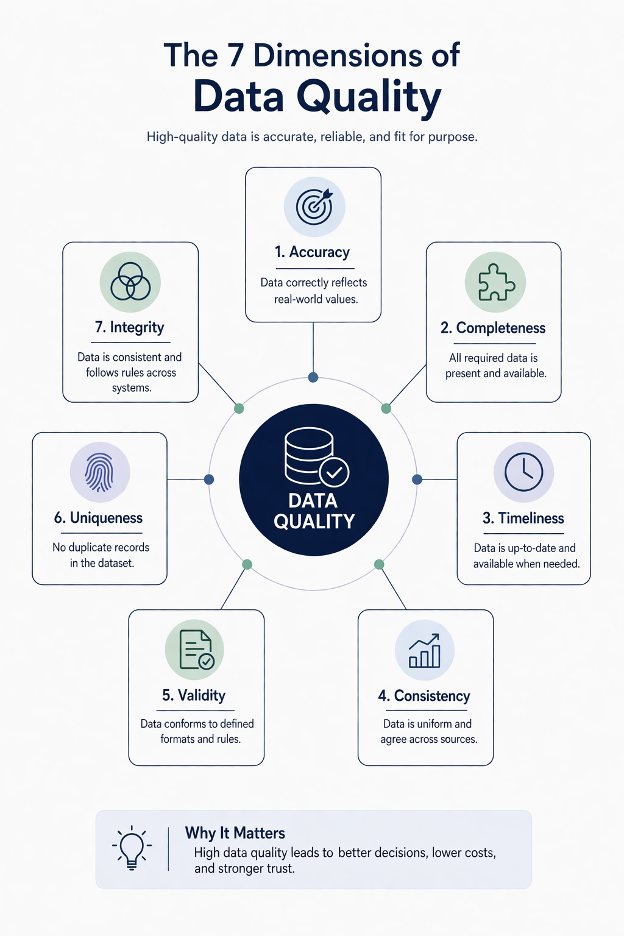
The 7 Dimensions of Data Quality: From Framework to Field Reality
DAMADMBOK defines the canonical dimensions. Gartner warns 59% of organizations don't measure them at all costing an average of $12.9M per year. Here's the complete framework and how to operationalize it.
Data quality has evolved from a backoffice concern into a boardlevel risk issue. The DAMA Data Management Body of Knowledge (DAMADMBOK 2) defines data quality as "the planning, implementation, and control of activities that apply quality management techniques to data, in order to assure it is fit for consumption and meet the needs of data consumers." That deceptively simple definition contains a critical phrase: fit for consumption. Quality is always contextual data perfect for one use case may be dangerously misleading for another.
"Bad data doesn't just slow you down it creates decisions that look confident but are structurally wrong."
The 7 Core Dimensions (DAMADMBOK 2 / ISO 8000)
DAMADMBOK 2 formalizes eight dimensions (Accuracy, Validity, Completeness, Integrity, Uniqueness, Timeliness, Reasonableness, and Consistency). The widely cited DAMA UK Working Group (2013) established six foundational dimensions. The most commonly applied set aligned with ISO 8000, Gartner's measurement toolkit, and enterprise practice converges on these seven core dimensions:
Dimension 01
Accuracy
Data correctly reflects the realworld entity it describes. Errors here carry the highest business risk wrong diagnoses, incorrect financial records, bad shipping addresses.
Dimension 02
Completeness
All required data is present and populated. Measures what is missing, not whether present values are correct. A 97% completeness score means 3 in 100 records lack essential fields.
Dimension 03
Consistency
The same data agrees across systems and time periods. A customer dateofbirth that differs between CRM and billing is a consistency failure, even if both values are present.
Dimension 04
Timeliness
Data is available when needed and reflects the current state of the world. Stale stock prices, outdated patient records, or old inventory counts produce wrong realtime decisions.
Dimension 05
Validity
Data conforms to defined formats, types, ranges, and business rules. A US zip code with 6 digits or a negative patient age fails validity regardless of accuracy or completeness.
Dimension 06
Uniqueness
No duplicate records exist for the same entity. Duplicate customers inflate marketing costs; duplicate transactions distort financial reporting and audits.
Dimension 07
Integrity
Referential relationships between data are preserved as it moves across systems. Every order must link to a valid customer broken integrity creates orphaned records and broken analytics.
Why Most Organizations Still Fail
Gartner research finds that 59% of organizations do not systematically measure data quality, meaning they have no way to detect deterioration. The same research estimates poor data quality costs organizations an average of $12.9 million annually in wasted effort, rework, and flawed decisions. Gartner's 2024 Magic Quadrant for Augmented Data Quality Solutions now renamed to emphasize AI found the market has pivoted from manual detection to AIpowered automated profiling, rule discovery, and remediation.
Gartner's Recommendation: Fitness for Purpose
Gartner advises against applying all dimensions equally to all data: "Select the data quality dimensions that are useful to your use cases and identify metrics for them. There is no need to apply all of them at once." Financial data demands accuracy and validity above all. Customer records need completeness and uniqueness. Operational logistics data hinges on timeliness. The 2025 Gartner report "How to Design an Effective Data Quality Operating Model" (Waite & Chien, July 2025) formalizes a sixcomponent Data Quality Operating Model for scaling this approach enterprisewide.
Key Practices for 2026
Implement automated profiling in every ingestion pipeline, covering all 7 dimensions per data domain
Define separate SLAs for each dimension completeness SLAs are different from timeliness SLAs
Track a "data reliability score" modeled on SRE reliability principles
Use anomaly detection to surface statistical drift before it cascades downstream
Treat data quality as a product owned by domain teams, not a remediation task for a central team